A Comprehensive Homeowner’s Guide to HVAC Replacement
Key takeaways:
• You may want to/need to replace heating and cooling components at the same time.
• Higher-efficiency units cost more upfront but can save on future utility costs.
• Proper sizing and installation are crucial for savings and comfort.
• HVAC financing can help you pay for a new system over time.
By Anne Fonda
What are some things to consider when it’s time for HVAC system replacement?
First of all, you may want to replace the indoor and outdoor units at the same time. This is especially true if both components are about the same age and are getting less efficient by the day.
If you have an aging system (15+ years) that requires frequent repairs, consider replacing the whole system versus just one component. Typically, with an older system, the technology has become obsolete, and new parts are not completely compatible with older systems.
Whether you’re replacing a single component or the entire system, there are 5 big factors to consider:
1. Efficiency
Everyone wants to save money on heating and cooling costs. According to the Energy Information Administration (EIA), for an average household, more than half of the annual energy consumption is due to heating and cooling.
So, by replacing an old and inefficient system with a new, energy-efficient HVAC system, you can reduce your energy consumption and save money on your utility bills.
Learn about the various HVAC terms for energy efficiency. In general, we would advise homeowners to purchase the most energy-efficient system they can, because it can provide enhanced comfort and long-term savings on energy costs for the next 15 years or so.
2. Number of speeds or stages
There are several types of heating and cooling systems:
- Single-stage
- Two-stage
- Multi-speed
- Variable speed
“The number of speeds or stages typically translates to energy efficiency and better comfort… so the more variability or number of stages, the more efficient the equipment will operate and the better temperature and humidity control the system can deliver to your home.”
-Mark Woodruff, Senior Product Manager, Ducted Air Conditioners

Learn more about the differences between single-stage, two-stage, multi-speed, and variable speed HVAC systems.
3. Sizing
Proper HVAC sizing is essential for an HVAC system to perform at peak efficiency. It’s also very important for your comfort and the lifespan of your system. If a system is too big or too small, you’ll have efficiency problems, higher utility costs, and disappointing heating and cooling.
“The only way to know for sure what HVAC system size you need is to have a load calculation performed on your home, which is a process usually done by an HVAC installer. The load calculation will take into account your home’s construction, the amount of insulation that you have, window efficiency (for example, single pane windows vs double pane), square footage, and your local weather to figure out what size system you need,” Woodruff said.
“Beware of HVAC companies that don’t perform load calculations and rely either on very basic rules of thumb or just want to replace your system with whatever you currently have. Those are usually signs that you should find a better company,” he added.
4. Quality installation
Just like an improperly-sized system will lead to problems, so will a shoddy installation. Hiring an HVAC contractor who cuts corners and determines an installation is “good enough” is something you want to avoid at all costs.
Work with a trusted and licensed HVAC company that is also NATE-certified. Learn more about how to find the best HVAC service near you.
Your HVAC system installation cost will vary widely depending on the system components, how energy efficient they are, how complicated the installation is, and more. Consult with your local American Standard dealer to get specific pricing.
5. Cost
HVAC system replacement can be expensive. Think of it as a long-term investment in your comfort. The cost is manageable if you finance your purchase. Learn about the best way to finance a new HVAC system.
What are the key factors to consider with AC replacement?
In addition to all of the factors above, you want to specifically check out an AC unit’s SEER2 rating and EER2 ratings.
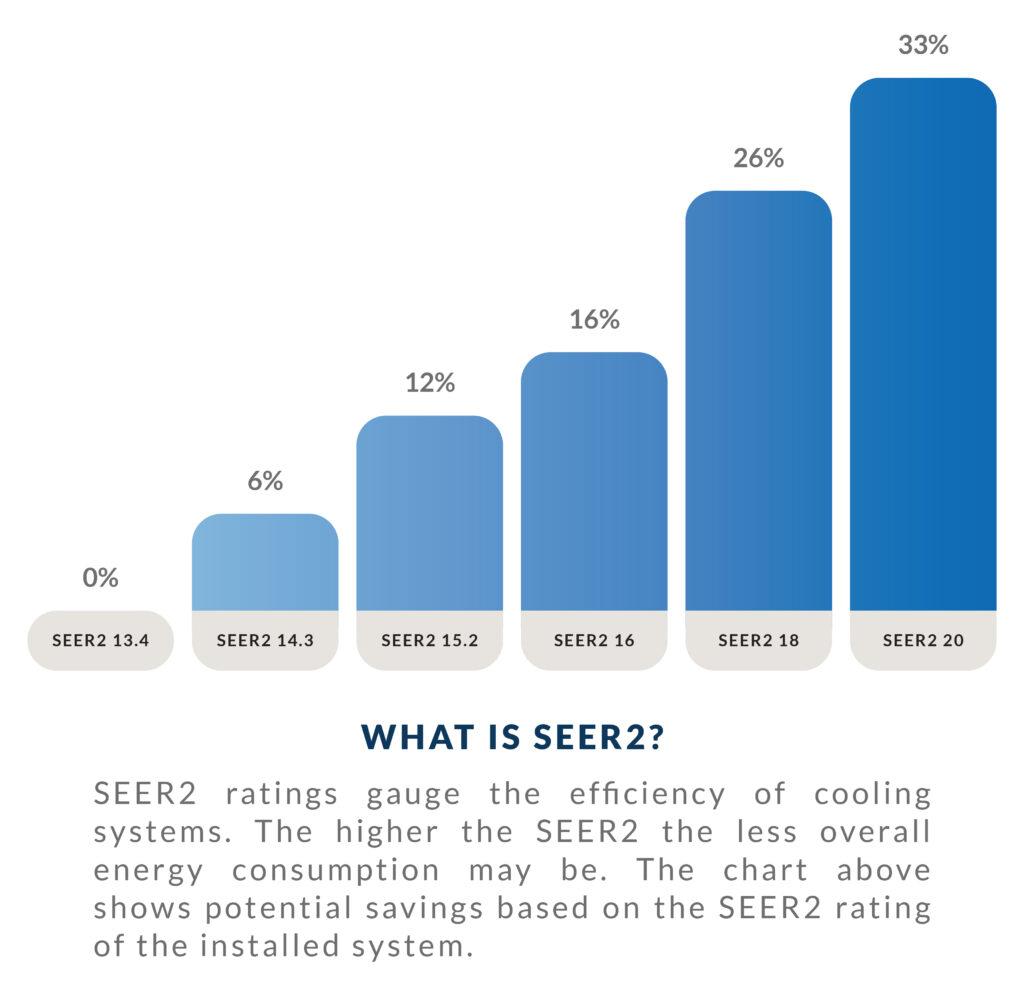
SEER2 stands for Seasonal Energy Efficiency Ratio, and measures an air conditioner or heat pump’s AVERAGE cooling efficiency over an entire season and a range of outdoor temperatures, from 65°F to 104°F.
The higher the SEER2 rating, the more efficient the AC system is. The following infographic compares the various SEER2 ratings.
EER2 stands for Energy Efficiency Ratio and measures a cooling unit's efficiency at a specific outdoor temperature of 95°F, indoor temperature of 80°F, and a humidity level of 50%. If you live where summers are long and hot and spring only lasts a week or two, a unit’s EER2 rating may be more important than the SEER2 rating.
Work with an experienced HVAC professional to find the right unit for your home.
Learn more about AC replacement.
AC replacement cost
Your central AC replacement cost will vary depending on the AC unit you choose. A more energy-efficient air conditioner with a higher SEER2 rating will cost more upfront, but can save you money on your cooling bills for years to come.
What are the key factors to consider with furnace replacement?
In addition to proper sizing and installation, you’ll want to decide how efficient you want your gas furnace to be. AFUEstands for Annual Fuel Utilization Efficiency, and measures how efficient a furnace is at converting fuel to heat your home.
The higher the AFUE, the more efficient the furnace is. For example, a furnace with an AFUE of 80 means that 80% of the fuel burned goes to heat your home, while the remaining 20% of fuel burned is vented out of your home as flue gas.
Any furnace with an AFUE of 90 or more is a condensing furnace with two heat exchangers for more advanced efficiency.
“A high-efficiency furnace makes sense in regions with colder climates and higher utility costs. These furnaces use less gas to produce the same amount of heat, which translates to lower energy bills for homeowners.”
-Amy Gulas, Senior Furnace Product Manager
Furnace replacement cost
Your furnace replacement cost will depend on the gas furnace you choose. A more energy-efficient furnace with a higher AFUE will cost more upfront but can save you money on your heating bills for years to come. Work with your local American Standard dealer to choose the best furnace for your home and climate.
What are the key factors to consider with heat pump replacement?
Efficiency, your air duct system, and the HVAC system you’re replacing are all important things to consider.
SEER2 and HSPF2 ratings
Since a heat pump both cools and heats your home, you need to consider both SEER2 and HSPF2 ratings. We already discussed SEER2 above. HSPF2 stands for heating seasonal performance factor.
It measures a heat pump’s heating efficiency over the course of a season. As with the SEER2 rating, the higher the HSPF2 rating, the more efficient the heat pump is at keeping your house warm in the fall and winter. A higher HSPF2 may be more important than the SEER2 rating if you have colder winters and milder summers.
You may also choose a hybrid heating system where you pair the electric heat pump with a gas furnace. The heat pump heats most of the time, but when the temperatures drop far enough that the heat pump starts to lose efficiency, the furnace takes over. When temperatures rise, the heat pump resumes heating responsibilities.
Another option is a cold climate heat pump, engineered to provide 100% of your heat down to single digits or below, depending on the unit.
Existing ductwork
Your home’s existing ductwork system plays an important part in any HVAC system, but it’s particularly important for heat pump system efficiency. Heat pumps have a higher airflow requirement compared to furnaces. Poorly designed or leaky ductwork can lead to wasted energy, higher utility bills, and uneven temperatures.
Evaluation of your existing ductwork and ductwork repair or replacement need to be considered by any HVAC company giving you a quote on a new heat pump system.
Heat pump replacement vs heat pump to replace furnace
If you’re replacing an existing heat pump and air handler system, things are pretty straightforward. However, if you’re replacing a furnace with an air handler, you need to be aware that you may need electrical upgrades and retrofitting.
However, if you and your dealer determine the 120V Modular Variable Speed Air Handler will work with your chosen heat pump and your space, you can avoid these extra costs. This air handler is designed to be a plug-and-play replacement for a furnace, with no electrical upgrades needed. It makes choosing electric heating more affordable.
Heat pump replacement cost
Your heat pump replacement cost will depend on the heat pump and air handler (or furnace) you choose to pair it with. A more energy-efficient heat pump with higher SEER2 and HSPF2 ratings will cost more upfront but can save you money on your heating and cooling bills for years to come. You may be eligible for heat pump rebates to help offset the cost.
Learn more about heat pump systems.
Work with your local American Standard dealer to choose the best heat pump system for your home and climate.
Don’t forget about your indoor air quality
Heat pumps, AC units, and furnaces get all of the attention when it’s time for HVAC replacement. But when you’re upgrading your heating and cooling system, don’t forget about some of the add-ons that can improve your comfort and improve your indoor air quality at the same time.
These include:
Whether you need (or could benefit from) any of these indoor air quality components will depend on your HVAC system, your home’s insulation, your local climate, whether you have allergies, and more. Discuss with your local American Standard dealer how one of these systems could enhance your health and home comfort.
Learn more about various aspects of indoor air quality.
Work with experienced HVAC professionals
A new HVAC system is only as good as the sizing and installation. When you work with your local American Standard dealer, they’ll perform a load calculation to help ensure you get the right-sized system for your home and climate.
On installation day, they’ll use the Tech App and Tech Assistant tools to follow step-by-step installation and testing procedures to help make sure you get a flawless installation. In this way, they can help you achieve the home comfort you deserve.
Anne Fonda, Content Writer
A Content Writer with Trane Technologies, Anne Fonda researches topics and writes for Trane® and associated residential HVAC brands. She works in collaboration with Trane Technologies subject matter experts, offering easy-to-understand, informative content on complex topics. Her goal is to help consumers make informed decisions on the products and services they need.
She has written for HVAC and other service provider websites for over 16 years. Before transitioning to web content writing, Anne had a 14-year stint as an award-winning journalist. She graduated cum laude from the University of Missouri-Columbia School of Journalism.
When she’s not working, Anne enjoys playing word games, reading, gardening, spending time with family, and visiting gardens and museums.
Expert review by Mark Woodruff, Senior Product Manager, Ducted Air Conditioners
Related articles


